Showing posts with label love. Show all posts

Friday, January 15, 2016

Moving Week

Monday was D Day, the day my father would be moving into a nursing home. In the morning I left home early and drove into the city to pick him up. Sue, the lovely woman who had cared for him overnight, had him dressed and ready for me, his bags packed and his flat orderly and neat.

He came along happily, with no idea where we were going, though I’d spoken about it with him several times. I told him his doctors had ordered him to rest. ‘How do they know I need it?’ he asked. ‘I haven’t seen them.’ He was right but I ignored that.


He’d barely slept the night before so he napped in the car. At the front door of the nursing home, a couple bringing along an elderly relative recognised him and he became animated as he remembered who they were. 

A nurse took us to his floor. On the way to his room we passed the activities room where a woman was playing the piano and singing and he stopped to sing along, his face lighting up. I asked him if he preferred to join in while I went to his room and he said he would. When I got back, the sing-along had finished and he was seated at a table in the dining room with a bib around his neck, eating lunch. 

It made me sad that he’d accepted this so easily. Shouldn’t he have thought it wrong, a case of mistaken identity perhaps, that he’d been shepherded to sit amongst a group of strangers with no introduction or explanation? Shouldn’t he at least have been surprised? (Though, to be honest, my dad loves meeting strangers and forging connections with them. It’s one of his favourite pastimes.)

It’s now Friday and I am surprised by how smoothly this transition has gone.

The worst experience we had was after dinner on his first day. I thought I’d get him into bed to make him feel more at home. He was tired, he said.

It began well and he allowed me to take off his shirt and put on his pyjama top. I even managed to get him sitting down and his incontinence pad and pyjama pants in position, ready to pull up. 

At that moment his brain froze and he didn’t recognise the pad.

We went back and forward for about 40 minutes while he studied the thing from all angles and kept saying it was wrong, while I told him that if he stood up I could pull his pants up and he’d see it was right. 

Normally I have endless patience for my dad but this was at the end of a long, anxious day for me. I’d got up early to drive him. I’d spent the day adjusting to the strange sights, sounds and smells of a dementia floor, and hovering over him while I watched for any sign of discomfort. Now I was drained. 

I went looking for a member of staff to help me and then I left. At that point he was naked from the waist down, unbuttoning his pyjama top, but two nurses were there to take over from me.

I drove home sobbing, more from exhaustion than anything else, and slept only fitfully.

The next morning my dad greeted me as he always does, with love and tenderness. He had had breakfast, been showered, shaved and dressed, his leg wounds bandaged, his support stockings pulled up, and he was ready to face the day with the same beautiful, kind, optimistic spirit that has stood him in good stead for the last 97 ½ years.

During the day he participated eagerly in the exercise class, he sang along at the concert. At lunch he slid his foil-wrapped pat of butter across to his neighbour. ‘You have that,’ he told him. It was all he had but he was eager to share it. As we walked around several of the nurses stopped me to tell me they recognised Dad from when they worked at the nursing home where my mother spent her last year. ‘What a wonderful man,’ they said. ‘What a devoted husband.’


Right now as I write this I miss my dad so much. I want to ring him and tell him all about these things. At the same time I feel like I can breathe properly for the first time in many months.

Wednesday, January 6, 2016

Baggage We Pack, Baggage We Carry

I bring up Dad’s small case from the garage, a piece of carry-on luggage, still with its Qantas tag attached.

In their day my parents crisscrossed the globe for business and pleasure. They made friends all over the world. In the 80s Dad was a director of Qantas. One year he and Mum flew on behalf of Qantas to the Boeing factory in Seattle to pick up a new 747-400 plane, ‘The City of Perth’.


Now the case is dusty with disuse. I bang it until the dust rises in a cloud. I pack into it a few pairs of trousers, some shirts and singlets, socks and toiletries. His needs are few these days. My heart aches looking at this case. This is no glamorous trip I’m preparing him for. Next Monday my dad will be checking into a nursing home for a few weeks’ respite. If it’s a success he might stay on.

In one of my dad’s notebooks there is a list of the clothes he used to pack for his overseas trips, all written in his distinctive handwriting with columns alongside for ticks as each item was added to the case. Now he has no idea how to pack or what to take.

The day I made the call to book Dad into the nursing home, I woke in the middle of the night, thinking about my Auntie Helen. When Helen was 20 and her younger brother Harry 18, he was diagnosed with paranoid schizophrenia and their parents, my grandparents, made her take him to Royal Park Psychiatric Hospital to be committed.


Although Harry’s behaviour was unpredictable and frightening and he needed treatment, and it was her parents’ decision not hers, Helen bore the guilt of her brother’s long incarceration for the rest of her life.

My uncle was given the treatment of the day – insulin coma therapy, where large doses of insulin were administered to induce a coma. My chest tightens when I read in the notes that he was very apprehensive about his treatment but his symptoms did abate. He was released but then the symptoms returned and he lived in institutions for the rest of his life. I remember him as a shambling wreck of a man, disheveled, incoherent and toothless.


Whenever I read of abuse and mistreatment in institutions I think of my uncle and wonder what he put up with. It doesn’t take a genius to work out why I am inundated with thoughts of Harry right now.

I decided to try a temporary placement for my dad in a nursing home because I felt he was becoming a prisoner in his own home. Because of his frailty, incontinence and confusion it’s become difficult to take him out of the house. In fact his only outings now are when I take him to the doctor. He does have the occasional visitor, but mostly he sits alone with his carers. Well-fed and well-cared for, but socially isolated. My hope is that a nursing home will provide activities and company.

I’ll be watching carefully. This is a light airy place, not the closed institution my uncle endured, but still I’m worried about this transition. I hope I’m making the right decision, and that it doesn’t worsen his condition. Time will tell, I guess. Meanwhile, I pack his suitcase with an aching heart.

Tuesday, May 5, 2015

Medication Zero, Dad Three

First, sleeping tablets failed. Then, desperate to find something to calm my father’s nighttime agitation, his psychogeriatrician prescribed an antipsychotic. That failed too. Next came an antidepressant, Avanza.

Avanza didn’t work. It didn’t help Dad sleep but made him so agitated and confused that several times he said he wished he were dead. All of that on only one small dose. One tablet. Even the next day he sat at the kitchen table with his shirt off, his hair all over the place, completely incoherent.

So many people described how Avanza helped them to sleep that a week later I tried again with a fraction of a pill. The confusion wasn’t as bad but it was definitely worse than usual and there was no improvement in his sleep.

Now we’d tried three different commonly used medications. None of them had worked and the side effects had been terrible. When I rang the doctor to report this he said that Dad would have to be admitted to hospital if we wanted to try anything else. That felt like a last resort to me. We retired to our corners.

In a way I was relieved. I dreaded seeing Dad drugged into submission. But still his nights were difficult. He wandered his apartment, searching for something he couldn’t name, positive that he should be somewhere, doing something important though he couldn’t for the life of him work out what that was.

He opened drawers, took things out – photographs, old letters, cards from him to Mum, from Mum to him, condolence cards on Mum’s death, business cards, receipts.  He’d put some of these inside the container on his walking frame, along with a roll or two of toilet paper, a couple of serviettes, wads of tissues. Later he’d take things out of there and leave them all over the apartment. Then he’d go searching for the things he’d hidden from himself.

This kept him busy and he didn’t have anything else to do or anywhere else to be, but it also distressed him, and I hated to see that. I decided to see how he went without medication for the moment, with the understanding that he just wasn’t going to sleep at night.


Meanwhile, my father’s dementia worsened. 

I called in to see him one morning. As usual he was so happy to see me. His hazel eyes shone and his face crinkled into a wide, welcoming smile. He kissed me on both cheeks. ‘Oh,’ he exclaimed with delight.

‘Dad,’ I said. ‘Why don’t you get dressed and come into the kitchen and have a cup of tea with me.’

He nodded. He was in the bathroom, bending over the toilet, stark naked, a bar of soap in his hand. ‘I’m doing exactly that,’ he said.

He reached his hands into the toilet and began to wash them.

‘Here, Dad,’ I said. ‘This is the toilet.’ I put the seat down so he might see it more clearly. ‘This is the basin.’ I turned on the tap.

Once he saw the running water he realised that was what he’d been looking for so he shifted his focus, began to wash his hands there.

I kissed him again. ‘Get dressed, Dad,’ I repeated. ‘Come into the kitchen and have a cup of tea with me.’

‘That’s what I’m definitely doing,’ he said. ‘I just need to do this first.’ He held his hands under the tap and began to soap them.

When my mother washed her hands in the toilet I thought it was the saddest thing I’d ever seen. I described it that way in my memoir of her Alzheimer's. That’s not how it felt to me this time. I’m not sure why. Maybe because I’ve seen it before. Maybe because I understand the confusion – water, washing. It makes sense to me.

What really bothered me was his lack of self-consciousness about his nakedness in front of me. This is not about my sensibilities; I wasn't the slightest bit embarrassed. I think he has a beautiful body still – well-built and strong despite being nearly a century old – but my father is an old-fashioned gentleman. A couple of times in years gone by I caught him in his drooping y fronts and he ran for cover, embarrassed. Now here he is going about his business completely naked with no awareness at all.

Slowly he got himself dressed, item by item, and somehow with his clothes he became more himself. He’d buttoned his shirt crookedly but otherwise he looked perfect. ‘Does my hair look alright?’ he asked me.

It did, I reassured him. ‘You look wonderful.’ He smiled. He had no idea he’d been naked in front of his adult daughter.


For now my father and I move forward like this: no dementia medication, gradually worsening confusion and, judging by his swollen ankles, worsening heart failure, taking each day as it comes, still loving each other, still kind to each other, still enjoying each other’s company.

Saturday, March 21, 2015

Apple. Table. Flag.

I've been here before - sitting in a psychogeriatrician's consulting room with a parent. The last time was with my mother while my father rode shotgun. This time it's my father who is in the hot seat while I have taken on his role as protector/interpreter.


I remember so clearly that day with my mother. 'Do you know what this is?' the doctor asked her, showing her his watch. She shook her head. 'And this?' he held up a pen. 'Do you know what this is for?' She didn't. He should have asked her if she knew who I was. That was a question she could have answered. That day at least. She comforted me there in the consulting room when I cried at her plight.

Sitting beside my father in the specialist's rooms I don't cry. I save my tears until later. Right now I am in competent mode, paying attention to my father's feelings and to what we need from this doctor.

The doctor asks us what we have come for, how he can help us. My father doesn't answer; he has no idea. He's here because he trusts me and I have brought him. I tell the doctor that my father has memory problems and that he barely sleeps at night, getting up, wandering around, confused and disoriented.

My father stares at me, his forehead furrowed in disbelief. 'I sleep very well,' he says. 'And I have a very good memory. I never forget anything.' My father is always loving and kind to me so he's not going to be rude but he's clearly puzzled and even shocked at my words.

'You don't mind if I test your memory?' the doctor asks.

'Not at all.' Actually there is some more conversation here and my father speaks slowly but articulately. Maybe he's not as bad as I feared. Maybe he's right and I'm wrong.

The doctor opens a printed test booklet. 'What's the date today?' he asks.

Dad concentrates but can't come up with an answer. This is not too bad. He's retired and spends most days at home. There's no reason for him to keep track of the exact date.

'That's fine. How about the month?'

Again Dad wracks his brain but can't find the answer. This is worse. It's easy to lose track of a day, but a whole month is a different dimension of forgetfulness.


'Now,' the doctor says, 'I'm going to say three words and ask you to remember them. Is that OK?'

My father nods. He's confident he'll be able to do this.

'Apple. Table. Flag.'

These are easy words. He'll remember them with no difficulty, especially because his oldest granddaughter grows apples on her organic farm. I say the words to myself, committing them to my own memory.

'Could you spell the word world backwards for me?' the doctor asks.

This is hard but Dad can't even manage one letter. He doesn't even try.

Now we're back to those words. Apple. Table. Flag. Does he remember them?

My father shakes his head. He doesn't say that one was a type of fruit and one was a piece of furniture, that they're on the tip of his tongue. He has no idea at all.

There are other tests but he fails them all. After a while the doctor says to me that he won't continue with the test; there's no point. It would only be upsetting.

We don't discuss the diagnosis. It's clear my father is suffering from dementia.

The doctor writes a prescription for a low dose of an anti psychotic to mitigate the sundowner effect that is common amongst dementia sufferers and that has my father confused and agitated in the late afternoon, and to help him sleep at night. At this point my father has fallen asleep in his chair.

We make another appointment. The doctor wants to give Dad some blood tests and see how he's going on the medication. Dad offers his hand, thanks the doctor who has been gentle and kind, and we leave.


At home I google the medication. Its side effects can include weight gain, dry mouth, drowsiness and even stroke or sudden death.

This is not what I want for my father but at the moment he dozes on and off all day and virtually doesn't sleep at all during the night. He gets agitated and aggressive with his carers and even with my older brother whom he adores. His behaviour is hard on him and even harder on his carers.

But I still feel I have failed him, that I should be able to find a way to manage him without resorting to these drugs.

And worse, I feel that I have caused the dementia. I took him to this doctor. It's because of me that he had these tests, which have led to a diagnosis, exposed his weakness to the world. If I hadn't taken him it wouldn't be true. He wouldn't have dementia. He'd just be old.

I know that what I have done is the responsible thing, that in fact I should have done it earlier. But in my heart I feel guilty of taking a lamb to the slaughter.

It's too early to tell how well the medication will work for my father. But the best I can expect is that he is calmer and sleeps better at night. That he's more 'manageable'. I feel cruel and even evil, though I don't know what else I can do.

There'll be more assessments and blood tests and I'm looking into respite care for a short period while two of his main carers are away, though he may not agree to go.

I just wish I could do better. I just wish I knew how to do this better. That's all.

Sunday, October 10, 2010

Feast and Famine

There is an interesting series of human interest videos on the ABC Northern Tasmania website. The overall topic is 'Change' but this has been interpreted in many ways.

I provided the producer, Richard Pree, with some scanned photos from our family albums, and a recording of me reading a couple of extracts from my book. He then put these together to produce a very moving short video.

The piece begins with a kiss. My father was in the Air Force, transferred from his home state of Western Australia to Melbourne, when he met a beautiful girl. My mother was 16 when they met and 18 when they married.


While I was looking through the albums I came across a photo of my mother at a party with the television star Graham Kennedy. Look how beautiful she is.


The piece ends with another kiss. This time my father is 90 and my mother 84. She has only months to live, but their love burns as brightly as it did at their first embrace. Even her Alzheimer's Disease cannot quench its flame.

Sunday, September 5, 2010

Happy Father's Day

Happy Father's Day to you dads, and to all you women and children who made them fathers.

It's funny, but even though I know that these Days are cynical marketing exercises, they still touch me. Especially I suppose as my own dad is now 92. Maybe it's pure sentimentality, but I do love to see families together, taking a moment to celebrate their parents.


This morning my older brother and his wife and I took my father out for brunch - a very Melbourne way to spend Father's Day. My father has a busy day ahead of him with the christening of a baby where he will be making a speech as a stand-in for the baby's late grandfather, and then dinner out with my younger brother and his family. My older brother will spend time later today with his children and baby grandson. Farmdoc's at home on the farm wrestling sheep, our children are scattered, and I am in the city wrestling with my novel, so he'll have to make do with phone calls.


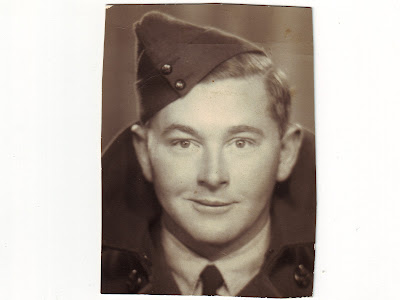
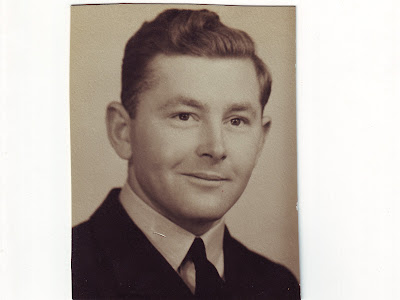
I've recently been going through old family photos. The ones on this post are of my dad in the airforce. In the top one he's 21-years old and the middle one was taken on his wedding day in Melbourne when he was 24 but looking much older. The bottom one is undated.


What about you? Do you celebrate Fathers Day, do you give gifts, or do you ignore it, refusing to be manipulated by the advertising industry? However you spend it I hope you have a lovely day.

Sunday, July 5, 2009

Happy Birthday, Dad


Happy ninety-first birthday, Dad!

I wish you continued health and fulfilment in your life, and for the pain of your grief to soften.

I hope that we all continue to love, cherish and enjoy each other as we do now for many years to come.

I love you very much and I am proud and grateful to be your daughter.

Tuesday, August 26, 2008

Dreams

When I was fifteen and on holidays with my parents I overheard a young woman talking on the public telephone in the lobby of our hotel. She was being extremely affectionate with the person on the other end of the line, who I was sure was her best friend, even though it could have been anyone – husband, boyfriend, mother, sibling.

I was shy and awkward and I wanted more than anything to have someone I could call darling and sweetheart on the phone.

That’s 45 years ago now, but I can still recall the longing I felt that day. It came to my mind yesterday when someone called me on my mobile.

‘Hello my darling one, can I call you back?’ I answered, almost without thinking.

‘Yeah, sure,’ she said.

As I rang off I was pierced so strongly by the memory of that longing that it brought tears to my eyes. Only this time it was with realisation: I now live my life surrounded by people I call sweetheart and darling, gorgeous and honeybum, people I love and care the world for.

I wish I could reach back to my fifteen-year-old self and tell her, ‘Don’t be sad. Not all at once, but bit by bit, you’ll get exactly what you want. And it’ll be just as you dreamed it would.’