

But then, just our luck, we struck a week of mostly fine weather and so were forced out of our armchairs and into our boots. Poor us!

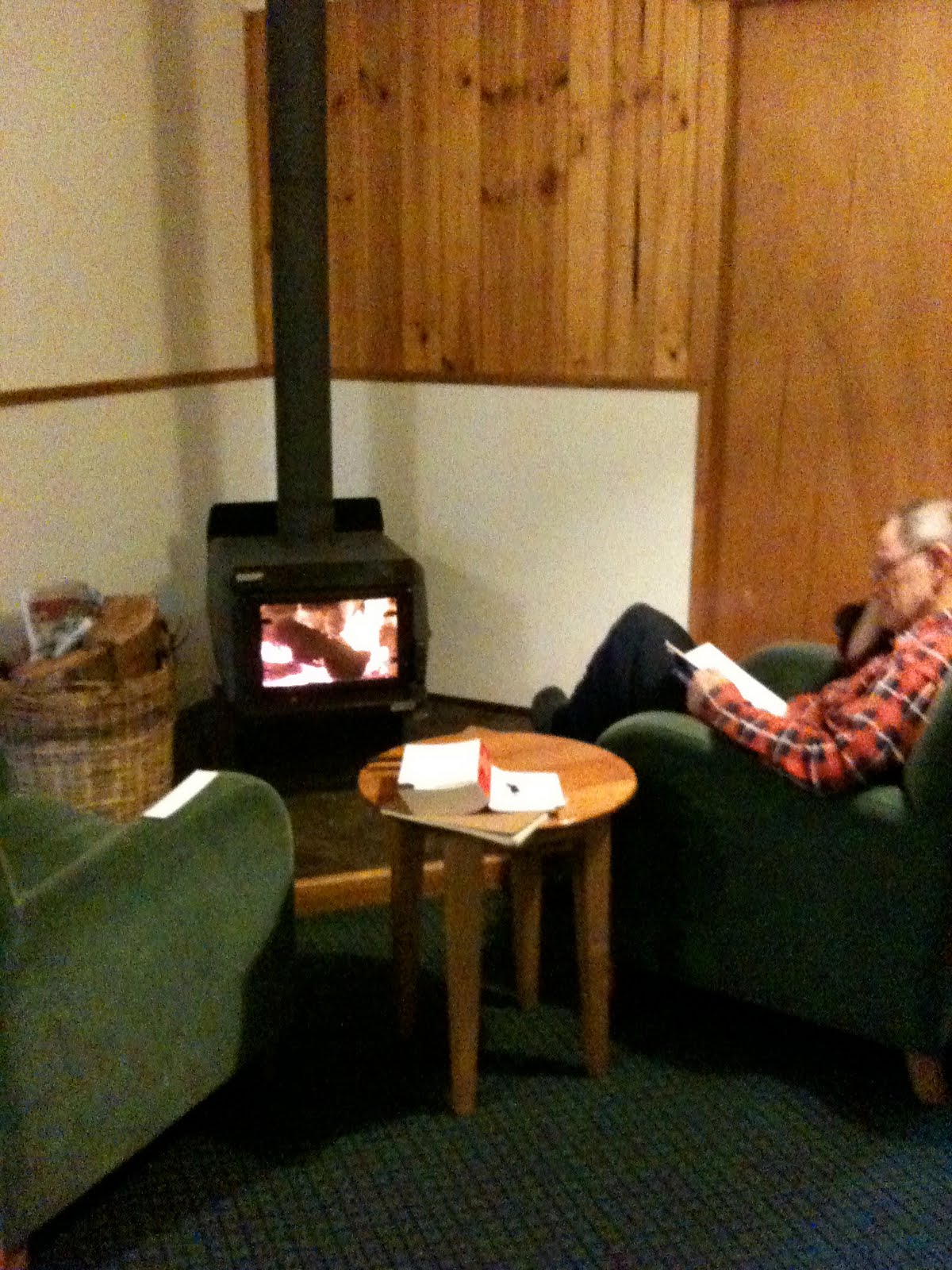
In the end we hit on a compromise. Every morning after an enormous breakfast we headed off for a walk. In the afternoons we'd light the fire in our cabin and read for the rest of the day. In this way we spent hours immersed in nature followed by hours immersed in literature.

My only issue with the scenery of Cradle Mountain is that it's hard to take a photo that doesn't look like one of those wilderness pictures that people who destroy the environment like to display. The kind of thing you see advertising banks, or toilet paper, or on show in airports.


I read five novels:

The Post-Birthday World by Lionel Shriver, a two-in-one novel that explores, in alternate chapters, two possible choices made by a woman who is torn between two men.
The Messenger, by Daniel Silva, a thriller about Gabriel Allon, art restorer and assassin, that moves between London, Jerusalem, the Vatican City, Venice, Rome, Paris and another dozen places at least and is utterly unputdownable.
On Chesil Beach, a novella by Ian McEwan. I often think McEwan's books, including Solar, his latest, would be better as novellas. This one is perfect. I actually read it twice. I especially like how the research is fully integrated into the novel and not presented as undigested lumps as McEwan sometimes likes to do and as Shriver does in The Post-Birthday World.
A Gate at the Stairs, by Lorrie Moore, a writer who I think does short stories best. I loved this novel because Moore is a superb writer so I was prepared to look away when her plot got away from her. But there are too many word tricks and maybe too much of everything for the book to truly work. Sometimes I found the writing so dense I could hardly breathe but at other times, perhaps when Moore isn't trying so hard, the novel just sings.
Wanting, by Richard Flanagan. I would have liked this novel to be longer. Its two subjects, the famous British writer Charles Dickens and the Aboriginal child Mathinna who was picked up and then abandoned by Sir John and Lady Jane Franklin in colonial Tasmania, seem to me to deserve more space. The Tasmanian section is heart breaking, but though Flanagan captures Dickens's England in all its filth and squalor, I didn't find Dickens himself convincing, so for me in the end the book's themes got a bit lost.

